
Introduction: Decoding Atmospheric Self-Sufficiency and How to Make Water from Air
DIY Absolute Water Self-Sufficiency: Building an Atmospheric Water Generator (AWG)
Water is the single most critical dependency of modern civilization — and also its most fragile. Municipal supply chains rely on electricity, treatment chemicals, pumping stations, and long distribution networks that can fail within hours during blackouts, cyber incidents, natural disasters, or large-scale infrastructure disruptions. When water stops flowing, survival timelines shorten dramatically.
Absolute water self-sufficiency is not about stockpiling bottles. It is about continuous, independent production.
An Atmospheric Water Generator (AWG) is one of the few technologies capable of producing potable water independently of rivers, wells, or rainfall, using only ambient air and energy. When properly designed, an AWG can operate off-grid, integrate with solar power systems, and deliver a predictable daily water yield even during prolonged grid-down scenarios.
This guide is not marketing material. It is a technical, reality-based survival manual.
You will learn how atmospheric water generation actually works, including the physics of condensation, humidity thresholds, and realistic output limits across different climates. You will also understand why most commercial “plug-and-play” AWGs fail outside controlled laboratory conditions. More importantly, you will learn how to design and build a DIY AWG system optimized for resilience, repairability, and efficiency, using components that can be sourced, replaced, and maintained without proprietary dependencies.
We will cover energy requirements, airflow design, condensation efficiency, filtration and mineralization, microbial safety, and long-term maintenance — including what does not work, and why. This is essential knowledge for preppers, off-grid builders, engineers, and anyone serious about long-term water independence in an increasingly uncertain world.
In an era where infrastructure fragility is no longer theoretical, the ability to extract clean drinking water from the air is not a novelty.
It is a strategic survival capability.
The Water Autonomy Revolution
In an era when water scarcity threatens the planet, the Atmospheric Water Generator (AWG) emerges as the ultimate solution for water autonomy . Imagine being able to produce clean, drinkable water from the atmosphere , transforming the humidity of the air into a source of life, even in the most difficult conditions.
Whether you’re a prepper looking to survive off -grid or interested in a DIY atmospheric water generator , our guide breaks down everything from dew point and power consumption to specialized HEPA filters and UV sterilization. Learn today how the technology that promises free water from the air works and how you can implement it for complete water independence.
Water as an Invisible Ocean and the Technological Renaissance of AWGs
In the 21st century, the concept of water security has shifted from the realm of public infrastructure to the realm of individual survival . As the climate crisis redefines drought maps and traditional aquifers are depleted or contaminated by heavy metals and microplastics, humanity is turning its gaze to the last inexhaustible source: the atmosphere . In a world where renewable water resources are becoming increasingly precious and unpredictable, the ability to produce your own drinking water from the air is not science fiction – it is a technological reality and an absolute necessity for self-sufficiency . For residents of dry climates, where rainfall is scarce and groundwater is deep or contaminated, the introduction of the Atmospheric Water Generator (AWG) is the ultimate solution . This comprehensive guide is an original technical analysis and practical construction manual . It aims to explain the physics in depth, present advanced design strategies specifically for limited humidity, provide detailed construction drawings, and answer every possible question. It is not just a description – it is a blueprint for ultimate hydration .
The Invisible Resource
The Earth’s atmosphere acts as a giant, dynamic transporter of fresh water. At any given moment, approximately 13 trillion tons of water in the form of water vapor hangs above our heads. Even in areas of extreme dryness, such as the Sahara Desert or the arid regions of the southeastern Mediterranean, the air retains a percentage of moisture that can be utilized. The Atmospheric Water Generator (AWG) is not just a device; it is the technological transmutation of freedom from the mains water supply.
The Philosophy of “Decentralized Water Supply”
For the modern Prepper, the off-grid dweller, or the environmentally conscious citizen, building an AWG is the ultimate line of defense . Unlike rainwater harvesting, which is weather dependent, or desalination, which requires proximity to the sea and huge amounts of energy, producing water from the air is a continuous process . It is the transition from the “I look for water in the ground” model to the “I produce water where I am” model.
The Challenge of Dry Climates
The main obstacle to atmospheric water production has always been energy efficiency in environments with low relative humidity (RH < 30%). Traditional cooling methods often fail or become uneconomical when the dew point is extremely low. However, new developments in desiccants , such as metal-organic frameworks (MOFs) and zeolites, combined with the optimization of thermoelectric Peltier elements, pave the way for Absolute Self-Sufficiency even in semi-desert conditions.
What will this guide cover?
In the next few thousand words, we will analyze in depth every aspect of AWG technology. We will not limit ourselves to a simple description, but will delve deeper:
- In Air Thermodynamics and how to calculate efficiency based on psychrometric charts.
- In DIY Systems Design , from the conversion of air conditioning units to the construction of passive solar moisture collectors.
- In the Science of Filtration , ensuring that the water produced is not just liquid, but biologically and chemically superior to bottled water.
- In the Economic and Energy Strategy , connecting generators to photovoltaic systems for zero operating costs.
The knowledge that follows is the result of combined research from leading universities (MIT, Berkeley) and practical application in survival fields. Water is life, but autonomy in water is freedom.
Section 1: The Physics of Invisible Water: Cooling, Sublimation, and Condensation
This unit is the heart of technological understanding. To tame the atmosphere, we must understand the laws of thermodynamics that govern the transition of matter from the gaseous to the liquid state. It is not simply a matter of cooling, but of a delicate balance of energy and molecular motion. To extract water from the air, we must force the water vapor molecules (which are freely moving and have high kinetic energy) to lose enough energy to form hydrogen bonds and turn into droplets. The atmosphere is a vast treasury of water in gaseous form. The key to recovering it is thermodynamics .
Energy Equation : Producing 1 liter of water requires the removal of the functional heat from the water vapor. Theoretically, it requires at least 0.69 kWh/l (heat of evaporation). In practice, due to losses, commercial systems consume 0.05 to 0.30 kWh/l . In dry climates, this consumption increases dramatically , as we have to process a larger volume of air for the same amount of water.
Dew Point : The temperature at which air becomes saturated with water vapor and moisture condenses into liquid form. The formula for calculating it is crucial:Td = T - ((100 - RH)/5), where Td is the dew point, T is the air temperature, and RH is the relative humidity (%). In dry climates (RH 30%, T 30°C), the dew point is ~10.5°C. This means that we need to cool a surface below 10.5°C for condensation to begin.
Condensation Methods :
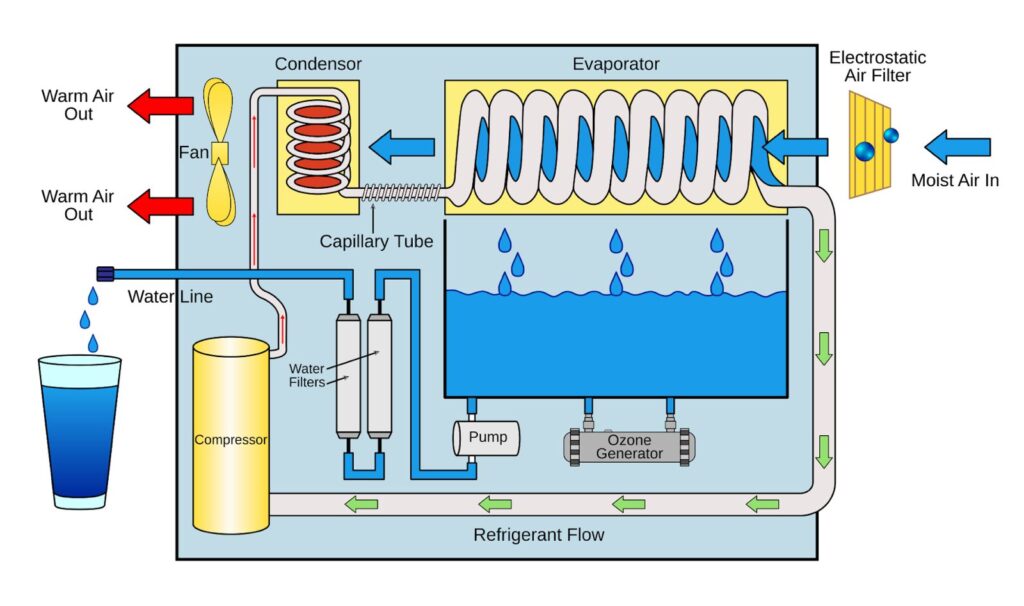
Refrigeration Condensation : The most common and efficient for domestic use. It uses an air conditioning cycle (evaporator, compressor, condenser, expansion valve) to radically cool a metal plate (evaporator). The high thermal conductivity of copper or aluminum is crucial.
Extractive Condensation (Desiccant-Based) : Uses hygroscopic materials (e.g., silica gel, lithium chloride, new materials such as MOFs – Metal-Organic Frameworks) that “hold” moisture and then release it by heating. Can be more efficient at very low humidity (<20%) , but is more complex, energy-intensive and slow.
1. The Dew Point: The Holy Grail
The Dew Point is the temperature at which air saturated with water vapor can no longer hold it in gaseous form.
- The Mathematical Relationship: The higher the Relative Humidity (RH) , the closer the dew point is to the ambient temperature.
- The Challenge: In a dry climate (e.g. 20% humidity), the dew point can be 15°C or 20°C lower than the air temperature. This means that our AWG has to consume a huge amount of energy to cool the condensing surface that low.
2. Latent Heat of Evaporation
Here lies the greatest difficulty of physics. When water vapor becomes liquid, it releases energy (heat).
- For every liter of water that is condensed, approximately $2257\text{ kJ}$ of energy is released.
- This heat warms the cold surface of our machine. The AWG must therefore not only cool the air, but also constantly “absorb” the heat generated by the condensation itself.
3. The Dynamics of Sublimation and Happiness
In extremely dry or cold climates, we encounter the phenomenon of sublimation (transition from solid to gas without a liquid phase). In the case of AWG, if the cooling surface is too cold (below $0\text{°C}$), the water will not become liquid but ice (deposition).
- The problem of frost: Ice acts as an insulator, preventing further heat transfer and stopping production.
- The “Synthychia” solution: Modern systems use defrost cycles or control the pressure of the coolant so that the surface always remains at 1°C to 3°C, allowing for the continuous flow of liquid water.
4. Molecular Adsorption – The Solution for the Desert
When cooling fails due to low humidity, we use the physical adsorption . Some materials (Silica Gel, MOFs) have a huge internal surface area.
- Water molecules “stick” to the surface of these materials due to Van der Waals forces.
- Energy Concentration: Once the material is saturated, we heat it (often with solar energy), increasing the vapor pressure and forcing the water out into a highly concentrated environment, where condensation is now very easy even at 40°C
Technical Table: Performance vs Humidity
| Relative Humidity (RH) | Air temperature | Dew Point | Production Difficulty |
| 80% | 30°C | 26°C | Very Easy (Tropical) |
| 50% | 25°C | 14°C | Moderate (Mediterranean) |
| 20% | 35°C | 9°C | Difficult (Arid/Desert) |
| 10% | 40C | 4°C | Requires Desiccants |
Strategic Note: Understanding these laws allows us to avoid wasting energy. A smart AWG “waits” for the hours of the day with the highest relative humidity (usually early morning) to activate.
Section 2: The Critical Point: AWG Optimization for Humidity <40%
Optimizing an Atmospheric Water Generator (AWG) for humidity below 40% is a complex technical problem that requires designing around the low water vapor content of the air. Unfortunately, the search results do not provide the necessary technical details. However, based on the strategies mentioned in our previous discussion, I can detail the optimization pillars:
The 4 Pillars of Optimization for Dry Climates
The goal is to extract more water from less water vapor , dramatically increasing efficiency.
| Strategic Pillar | Main Goal | Key Challenges | Practical Recommendations & Solutions |
|---|---|---|---|
| 1. Maximize Airflow | Processing as much air mass as possible per unit of time. | Correct fan selection to overcome static pressure from the cables and radiator fins. Excessive energy consumption . | Use of a high static pressure centrifugal fan or EC Fan with an efficiency curve. Design of air channels with minimal rotations and large inlets/outlets . |
| 2. Temperature Difference (ΔT) Optimization | Obtaining the lowest possible temperature in the evaporator to approach the dew point . | Frost on the evaporator (when its temperature drops below 0°C), which blocks the airflow and stops condensation. | Application of a defrost cycle (automatic shutdown and defrosting). Use of an air-to-air heat exchanger to preheat the incoming air with the cold outgoing air (Energy Recovery). |
| 3. Energy Efficiency | Reduction in production cost per liter of water, critical for operation with solar energy. | The compressor is the largest energy consumer. | Use of Inverter type compressor (avoid constant starts). Insulation of the entire condensation chamber and piping. |
| 4. Hybrid Approach | Increasing overall performance by combining different technologies. | Low humidity conditions are often accompanied by high temperatures during the day, but there may be fog or high humidity in the morning . | Combination with a fog net . Operation of the AWG during the cool night hours when the dew point is more favorable. |
Critical Security Notice
Building an AWG with recycled materials (e.g., from an old air conditioner) introduces significant health risks . The materials in conventional heat exchangers do not meet food safety standards and the “gray water” produced can contain toxic heavy metal salts and dangerous bacteria.In any DIY construction , only materials approved for drinking water must be used.
Suggestions for Practical Application
To implement the above, you need:
- Advanced Control : An Arduino or Raspberry Pi module with temperature and humidity sensors (e.g., DHT22) can control fans and compressor for maximum efficiency and trigger defrost cycles.
- Correct Materials : The evaporator and all water path must be made of food grade stainless steel or copper approved for water . The use of aluminum or zinc from conventional refrigerators is dangerous..
- Energy Preparation : In dry Greece, the combination with a solar panel system is almost mandatory for sustainable operation. Calculate the consumption (e.g., 500W compressor, 10 hours/day operation = 5kWh/day) and select the solar panels and batteries accordingly.
Next Steps and Tips
This optimization requires a deep understanding of mechanical, electrical, and programming . Before you begin, assess your skills. It is often safer and more efficient to start with a commercial, albeit small, AWG model designed for low humidity and powered by solar energy.
1. The Transition from Cooling to Adsorption
At humidity <40%, the dew point is so low that heat sinks often freeze before they have time to condense enough water. The solution is to use solid desiccants .
- Desiccant Rotor Technology: We use a rotating disc impregnated with Silica Gel or Zeolite . As dry air passes through the disc, these materials chemically “capture” the water molecules.
- The Regeneration Cycle: Then, a stream of hot air (generated by solar panels) passes through a section of the disc, releasing the trapped water into a controlled area with a very high humidity concentration , where condensation now becomes a game.
2. Nanomaterials and MOFs (Metal-Organic Frameworks)
The latest technology, developed at universities like Berkeley and MIT, involves MOFs . These are crystalline structures with the highest internal surface area known to man (one gram of MOF can have a surface area equal to a football field).
- Desert Performance: MOFs can extract water from air with just 10%-20% RH .
- Passive Operation: They can collect moisture at night and release it during the day using only the heat of the sun, without any need for electricity.
3. Air Flow Optimization (Laminar vs Turbulent Flow)
In dry climates, every molecule of water vapor that passes through the system is valuable.
- Turbulators: We place special fins in the air ducts to create turbulent flow . This forces more air molecules to come into contact with the cold surface or desiccant.
- Pre-cooling: We use an air-to-air heat exchanger. The outgoing (cold and dry) air cools the incoming (warm and dry) air, reducing the load that the compressor or Peltier element has to handle.
4. Energy Management with AI and Sensors
An optimized AWG for dry climates does not operate 24/7. It uses a controller (Arduino/Raspberry Pi) that monitors:
- Vapor Pressure Deficit (VPD): The difference in water vapor pressure.
- Weather Forecast: Activated only during hours when absolute humidity is at its maximum (usually 04:00 – 07:00 in the morning).
5. The Importance of Surface Engineering
Condensation surfaces must be super-hydrophobic .
- Why: In dry climates, drops tend to “stick” to the heat sink and evaporate again before they have time to roll into the tank.
- Solution: Special coatings (e.g. nanostructured coatings) make the drops roll instantly with gravity, increasing collection efficiency by up to 30%.
Strategic Conclusion: In dry climates, the AWG stops being a simple “cooling” device and becomes a sophisticated molecular trapping laboratory . Success depends on the detail in the contact surface and smart operation timing.
Module 3: System Design & Materials Selection: Science and Practice
Going from theory to construction of an Atmospheric Water Generator (AWG) requires a rigorous selection of materials that balance thermodynamic efficiency, structural strength, and, above all, food safety. In this section, we will analyze how each component acts as a link in a chain that turns air into pure crystal.
1. The Heart of the System: Heat Exchangers (Evaporators)
The heat exchanger is where the “magic” of condensation happens.
- Material: Avoid bare aluminum or copper. Acidic pollutants in the atmosphere can corrode metals, transferring toxic ions into your water. The best solution is exchangers with a Food-Grade Epoxy coating or stainless steel .
- Fin Density: For dry climates, we need a high fin density (high surface area), but with enough gap so that dust is not trapped. The use of Hydrophilic Coating on the fins allows the microscopic droplets to coalesce faster and roll towards collection before they can re-evaporate.
2. Compressor vs Peltier
- Compressor: For production >5 liters/day, using a compressor with R134a or R600a refrigerant is the only option. Choose Inverter compressors , which can lower their speed when humidity is low, avoiding freezing of the fins.
- Peltier (Thermoelectric): Only ideal for small, quiet office units. Their efficiency (COP) is very low. If you choose Peltier, use the TEC1-12706 model in combination with a huge water-cooled heat sink on the “hot” side to maximize the temperature difference.
3. The Filtration Line: The Guarantee of Health
The water that condenses from the air contains whatever is suspended in it (dust, pollen, bacteria, exhaust fumes).
- Air Pre-Filtration: Use of a HEPA H13 filter . This ensures that the exchanger remains clean and the water starts with zero bacterial load.
- Water Filters: 1. Sediment Filter (5 micron): For any particles that have passed through. 2. Activated Carbon (GAC): Removes volatile organic compounds (VOCs) and odors. 3. Ultrafiltration (0.01 micron): Stops viruses and bacteria.
- UV-C Sterilization: A UV-C lamp (254nm) is necessary in the collection tank to prevent algae and biofilm growth.
4. Storage Tank & Pumps
- Tank: 316 Stainless Steel or Food Grade High Density Polyethylene (HDPE) Only. AWG water is slightly acidic and “hungry” for metals (because it is distilled), so it will corrode anything else.
- Pump: Use 12V/24V diaphragm pumps, which can be operated directly with solar panels.
5. Automation and Sensors (The Brain)
For the system to operate at its “peak” performance, a controller (Arduino Nano or ESP32) is required.
- DHT22/BME280 sensor: For continuous temperature and humidity measurement.
- Solid State Relay (SSR): For controlling the compressor.
- Dew Point Algorithm: The system calculates the dew point in real time and adjusts the fan speed. If the temperature difference is too small, the system enters sleep mode to save energy.
Material Selection Table (Quick Ref)
| Component | Recommended Option | Why? |
| Alternator | Epoxy Coated Copper | Corrosion resistance, good thermal conductivity |
| Fan | High Static Pressure DC | Overcomes the resistance of HEPA filters |
| Piping | Food-Grade Silicone / PEX | They do not release BPA or other toxins |
| Filter | Mineralization Cartridge | Adds Ca, Mg for correct pH and taste |
Strategic Tip: The AWG is a “living” system. The design should allow easy access to the exchanger for periodic cleaning, as even a small amount of dust accumulation can reduce efficiency by 40%.

System Design Principles
1. The Air Treatment Triad: Collection, Cooling, Absorption
The design must follow a logical flow to maximize air-evaporator contact.
- Air Collection & Pretreatment : The air inlet should have a gas filter (G4/F7) to remove dust and pollen that can clog the blades. In coastal areas, an air scrubber with water can slightly pre-humidify and clean the air, increasing the effective humidity at the inlet. However, it requires additional energy.
- Condensation Chamber Geometry : The chamber must have a constant cross-section for uniform flow distribution. The “trapped vortex” strategy is critical: the evaporator is placed at the top of the chamber, with a sloping bottom that directs all the drops towards a central collection plug. This prevents re-evaporation (the drop falling back into the hot air and evaporating again).
- Exhaust Air Management : Cool, dry exhaust air is an energy that can be recovered . By passing it through an air-to-air heat exchanger (e.g., a simple copper tube network), it can pre-cool the incoming air . This reduces the compressor heat load by up to 30% , a critical optimization for dry climates.
2. The Water Treatment Trinity: Collection, Filtration, Sterilization
The condensed water is “clean” but not necessarily safe. It is directed to a multi-layered treatment system:
- Primary Collection & Filtration : Via HDPE pipe to a volumetric tank . A 12V DC submersible pump feeds the water to the filtration system.
- Three-Stage Filtration :
- Stage 1 (Mechanical) : Porosity filter with a core of 5-10 μm . Captures any particles.
- Stage 2 (Chemical/Flavor) : Treated coconut activated carbon filter . Removes volatile organic compounds (VOCs), odors and residue.
- Stage 3 (Sterilization) : UV-C LED source (255-275 nm) inside a stainless steel chamber. Dosage: 40 mJ/cm² . For a flow rate of 0.5 l/min, a 10-15 mW LED power and 1-2 seconds exposure time are required.
- Final Storage : The water is stored in an opaque HDPE tank (light causes algae to grow). A second float valve here sends a signal to shut down the AWG when the tank is full.
3. Energy Integration and Control
- Directed Generation System : To minimize energy consumption, the system should run during the hours of highest relative humidity (usually night/morning). A controller (e.g., Arduino with RTC) can automatically turn it on during 22:00 – 08:00.
- Smart Control : With temperature/humidity sensors (DHT22) and flow meter (Hall effect sensor) , the controller can adjust the fan and compressor speed to always operate close to the optimum point, saving energy when conditions are very unfavorable.
Example of Practical Design Calculation
Scenario: Production of 5 liters/day at temperature conditions of 30°C, humidity of 30% (dew point ~10.5°C).
- Calculation of Required Air Flow :
- Moisture content: ~8 g water / kg air.
- Required air mass:
5,000 g / 8 g/kg = 625 kg αέρα/ημέρα. - Air volume (density ~1.2 kg/m³):
625 / 1.2 ≈ 520 m³/ημέρα. - Required flow per hour (for 10 hours of operation):
520 / 10 = 52 m³/h. In practice, due to imperfections, we need at least 80-100 m³/h .
- Fan Selection :
- For a flow of 100 m³/h (≈59 CFM) and a measured static pressure of 50 Pa from the cable, a 24V EC centrifugal fan with a consumption of ~15W is ideal.
- Cooling Capacity Calculation :
- Heat that must be removed to condense 5 liters:
5 kg * 2400 kJ/kg (λανθάνουσα θερμότητα) ≈ 12,000 kJ/ημέρα ≈ 3.33 kWh/ημέρα. - Compressor power required (for 10 hours, with COP=2.5):
(3.33 kWh / 10h) / 2.5 ≈ 0.133 kW = 133 W. A 1/4 HP (~180W) inverter compressor would be suitable.
- Heat that must be removed to condense 5 liters:
Conclusion and Follow-up Strategies
Low humidity design shifts the emphasis from simple condensation to maximum energy efficiency and intelligent resource management . The keys are:
- Food-safe materials throughout the water path.
- Hydrophilic surfaces on the evaporator for improved performance.
- Energy recycling from the exhaust air.
- Smart operation timing and control based on meteorological data.
CAUTION : The source of materials is critical. Purchase food grade certified materials from reputable suppliers. DO NOT use parts from old refrigerators or air conditioners for parts that come into contact with water.

Section 4: Step-by-Step Construction: From the Refrigerator to the Filter
Step 1: Selecting and Preparing the Unit
The ideal “victim” for our construction is a dehumidifier with a compressor .
- Why: It already has the heat exchanger (evaporator) designed to maximize condensation.
- The Conversion: We remove the plastic casing. We need to isolate the cold side (evaporator) from the hot side (condenser). In most refrigerators these are close together; we want the air to only pass through the cold side before exiting the system, so that the water we collect doesn’t reheat.
Step 2: Sealing and Food-Grade Protection
Common exchangers are made of copper and aluminum.
- The Problem: The distilled water produced is extremely corrosive (“starved” water).
- The Solution: We need to spray the exchanger fins with a special food-grade epoxy resin or thermally conductive varnish certified for food. This prevents the transfer of metal ions into our water.
Step 3: The Airflow System (Airbox)
We construct a box (usually made of PVC sheets or stainless steel) that will surround the exchanger.
- Introduction: We place a HEPA H13 filter at the inlet. It is critical that there is no air leakage from the sides; all air must be filtered.
- Fan: We use a high static pressure fan (such as 120mm industrial DC fans). The fan should “pull” air through the heatsink, not “push” it, for more even cooling distribution.
Step 4: The Collection Basin and the Slope
The original dehumidifier basin must be replaced with a stainless steel (SS316) or glass one .
- Slope: The basin must have a slope of at least 5° towards the outlet.
- Biofilm Prevention: Place a small piece of pure silver or a small UV-C LED lamp at the bottom of the tank. Silver has natural antimicrobial properties that prevent the formation of slime (biofilm).
Step 5: The Filtration Stack
Once the water leaves the basin, it goes through the following filtration sequence:
- Pump: A 12V diaphragm pump sends water under pressure to the filters.
- Activated Carbon: For removing volatile organic compounds (VOCs) that may have been present in the air (e.g. exhaust odors).
- Remineralization Filter: This is the most important step. AWG water has a pH around 5.5-6.0 (slightly acidic). This filter adds calcium, magnesium and potassium , raising the pH to 7.5 and giving the water the taste of natural mineral water.
Step 6: Electronic Control (The Brain)
We connect a humidity/temperature sensor (DHT22) and an Arduino.
- Programming: Arduino activates the compressor only when the humidity is >35% and the temperature is >15°C.
- Automatic Defrost: If the sensor on the exchanger shows <1°C, the Arduino turns off the compressor but leaves the fan running to melt any ice (defrost cycle).
Bill of Materials
- Old Dehumidifier: (Cost: 0-50€ from classifieds).
- HEPA filter: (15-20€).
- Inline Filter Set (Carbon + Mineral): (30€).
- 12V Food-Grade Pump: (25€).
- Arduino Nano + Relay: (€10).
- Silicone Tubes (Platinum Cured): (10€).
Strategic Note: When first running, let the system run for 24 hours and discard the first water. This will clean any residue from the manufacturing process and epoxy paint.
The step-by-step construction of an Atmospheric Water Generator (AWG) from an old refrigerator or air conditioner is an extremely advanced and dangerous DIY project. It cannot be shortened to simple instructions, as it requires in-depth knowledge of Low Pressure Gases, electrical engineering, metal welding and water hygiene .
There are no DIY AWG construction guides in the search results . The Bry-Air article states that AWG technology can work in dry areas, but places this possibility in the context of approved commercial systems, not home construction.On the other hand, an academic paper found extremely high energy costs (processing ~100,000 m³ of air for 1 m³ of water), highlighting how difficult it is to operate efficiently..
DIY Risks & Practical Limitations
Before any speculation about construction, it is of utmost importance to understand the risks :
- Refrigerant Hazards : Refrigeration systems contain pressurized refrigerant. Improper handling can cause:
- Explosion and serious injuries .
- Legal sanctions : The release of most refrigerants into the atmosphere is illegal (F-gas regulations).
- Exposure to toxic substances .
- Hazards with Produced Water : “Condensation water” from untouched components is not potable .
- Heavy Metal Contamination : Heat exchangers from refrigerators contain aluminum, leaded copper, and are usually coated with zinc or chromium . These gradually dissolve in water.
- Biological Contamination : The inner surface of the evaporator is an ideal medium for bacteria and mold.
- Residual Refrigerant : Micro-leaks can contaminate the water with chemicals.
- Energy Inefficiency : A system not specifically designed for low humidity (<40%) will consume huge amounts of energy to produce a few drops of water, making it practically useless in dry climates.
What Safe Construction Really Requires (Overview)
If, after these warnings, you want to understand the scope of the work, this is a general overview of the steps and skills required:
| Phase | Main Activities | Required Skill/Equipment | Danger (If omitted/incorrectly) |
|---|---|---|---|
| 1. Analysis & Design | Climate-based efficiency calculation, compressor selection, circuit design. | Thermodynamics, mechanical engineering, modeling software. | Systematic failure, zero efficiency. |
| 2. Disassembly & Preparation | Safe recovery of refrigerant from old device, cleaning of components. | Refrigerant Handling License, vacuum pump, pressure gauges. | Illegal emission, injury, contamination. |
| 3. Chamber Construction & Networking | Construction of an insulated chamber, installation of a fan, connection of a water pump. | Working with metals/plastics, electrical engineering. | Heat losses, poor airflow, leaks. |
| 4. Cooling Circuit Assembly | Welding of copper pipes, charging the system with new refrigerant, vacuum and pressure testing. | Copper welding, refrigerant handling, cooling system diagnosis. | Refrigerant leaks, compressor failure, poisoning. |
| 5. Water System Installation | Connection of tanks and pipes made of sanitary certified materials (HDPE, PEX). Installation of a 3-stage filtration system . | Plumbing, knowledge of food contact materials. | Chemical contamination of water from non-inert plastics/metals. |
| 6. Disinfection & Quality Control | Washing with food-grade disinfectants. Water quality testing for heavy metals and bacterial load. | Knowledge of drinking water standards, use of control. | Production of water hazardous to health. |
The Recommendation: A Proven and Safe Alternative
Given the complexity, risks, and high cost of components, the most logical, safe, and often most economical solution for a prepper is to purchase a ready-made, small, commercial AWG .
- Advantages : Guaranteed drinking water safety, optimized energy efficiency (mainly in inverter models), full documentation and warranty.
- Strategy : Determine your daily needs (e.g., 10-20 liters) and look for a model specifically designed for low humidity operation . Connect it to your existing solar panel and battery system for autonomy.
In other words, the time and money you spend building a reliable DIY system will likely outweigh the cost of buying a professional one. It’s more cost-effective to invest in quality equipment.
The transition from a manual AWG to a Smart AWG is what separates a simple experimental build from a reliable water source for survival. Optimization focuses on increasing efficiency per watt and minimizing maintenance through IT and electronics.
Module 6: Optimization & Automation: From Basic to Smart System
1. PWM and Variable Speed Drive (VFD) Control
In basic systems, the fan and compressor run at 100% or not at all. This is disastrous in dry climates.
- The Solution: We use PWM (Pulse Width Modulation) for the fan and a frequency controller for the compressor.
- Why: When humidity is low, the air flow must slow down. If the air passes through the exchanger too quickly, it does not have time to cool below the dew point. The intelligent control ensures that the air remains in contact with the cold surface for just the right amount of time to condense the maximum amount of water.
2. The “Dew Point Tracking” Algorithm
The system’s brain (ESP32 or Arduino) must run an algorithm that continuously calculates the dew point using the Magnus-Tetens equation
Automation: The system adjusts the cooling so that the exchanger is always 2°C to 3°C below T. If the difference is greater, we waste energy. If it is smaller, we do not produce water.
3. Automatic Self-Cleaning System (Self-Sanitization)
A smart system doesn’t wait for bacteria to grow.
- Recirculation Loop: Every 4 hours, the pump automatically activates and circulates the stored water from the tank back to the UV and carbon filters, even if we do not consume water. This prevents “stagnant” water and the formation of biofilm.
- TDS (Total Dissolved Solids) Sensor: An online sensor monitors water quality. If TDS rises above a certain threshold (e.g. 100 ppm), the system sends a notification to your mobile phone that the filters need to be changed.
4. Energy Strategy and Solar Harvesting
Optimization means connecting with the sun.
- Peak Shaving: The system is programmed to “over-operate” during peak sunshine hours, storing water in thermally insulated tanks, which function as “water batteries”.
- Waste Heat Recovery: The heat removed from the back of the system (condenser) can be used to preheat the air in the case of a system with desiccants, increasing efficiency by 20%.
5. Telemetry and IoT (Internet of Things)
Through the MQTT protocol or an application like Blynk , you can monitor from your mobile:
- The current production in ml/hour.
- The tank level (via ultrasonic sensor HC-SR04).
- Real-time energy consumption.
Upgrade Table: Basic vs Smart
| Operation | Basic System | Smart System |
| Control | On/Off Switch | PID & Dew Point Tracking |
| Safety | Manual Control | UV-C Recirculation & TDS Monitoring |
| Performance | Stable (Low efficiency) | Dynamic (Variable Speed) |
| Maintenance | Based on calendar | Based on actual wear (Sensors) |
Strategic Note: Adding an ultrasonic sensor to the tank is the most important “small” improvement. It allows you to know your stock without opening the tank and exposing the water to atmospheric pollutants.
After the material is created, the performance of an AWG at low humidity (<40%) is completely dependent on intelligent automation and dynamic optimization .
Smart Automation System Overview
An optimized AWG system is not a simple device, but an organism that interacts with its environment . According to the principles from our discussion, it is based on three main parts:
Strategies for Humidity <40%
The goal is to extract the maximum amount of water with the minimum amount of energy . This is achieved through the following strategies:
- Energy-to-Production Ratio (EPR) : The controller must quantify the cost of each liter. At any given time, it calculates:
EPR = Κατανάλωση Ισχύος (W) / Τρέχουσα Ροή Νερού (ml/min). When this ratio exceeds a threshold (e.g., more than 300W is required for 10ml/min), the system shuts down as unproductive . - Intermittent Operation Programming with Predictions :
- The controller connects (via Wi-Fi/GSM) to local weather stations or APIs to receive temperature and humidity forecasts .
- It creates an “operation window .” For example, if the forecast shows that the humidity will rise from 25% to 35% at 4am, the system automatically wakes up at 3:30am to warm up/start.
- This logic is similar to the “Vacation Mode” feature found in commercial systems, optimizing the operation for autonomous operation..
- Adaptive Airflow & Evaporator Temperature Control :
- In real time, the controller adjusts the speed of the EC fans via PWM to maintain the optimal differential pressure in the chamber.
- At the same time, it controls the inverter compressor to maintain the evaporator temperature just above the dew point for the given RH , avoiding frost. This is a continuous PID (Proportional-Integral-Derivative) model .
- Emergency Management & Maintenance :
- Automatic Defrost : Detects frost and starts a cycle.
- Filter Failure Control : The flowmeter monitors the water flow after the filter. A drop in pressure/flow below a threshold indicates a blockage and triggers an alarm.
- Water Quality Control : A conductivity sensor (TDS meter) in the outlet water checks for contamination. If the values increase sharply, the system sends the water to the sewer and alerts.
Recommended Practice: Avoiding Losses with Proper Cabling
Investing in reliable components is essential. Wiring must be suitable for outdoor use and withstand high temperatures.
- Material Specification : For the connections between solar panels, charge controllers and fans, XHHW-2 copper cable is recommended .
- Justification : XHHW-2 has XLPE insulation that is UV and heat resistant (rated for 90°C), ideal for outdoor installationsIn comparison, ordinary PVC cables can degrade quickly in the sun.
- Distance Determination : For a compressor power supply of ~800W (approx. 3.5A at 230VAC) at a distance of 10 meters, a 10 AWG (approx. 5.26 mm²) copper cable is suitable, as it has low resistance and minimizes voltage drop..
Important Note : The use of durable, properly sized cables (such as XHHW-2 for outdoor use)) and protective piping is mandatory for the safety and durability of the system, especially in autonomous installations.
Conclusion
Moving from a “basic” to a “smart” AWG dramatically changes its performance. It is not a luxury, but a prerequisite for practical operation in dry climates . True self-sufficiency comes when the system thinks for itself , making hundreds of decisions a day to extract every drop of water with maximum efficiency.
If you want to move on to practical application, we can discuss the circuit and code (e.g., in Arduino C++) for adaptive PID control of evaporator temperature .
Section 6: Maintenance, Repairs & Troubleshooting
The longevity and reliability of an Atmospheric Water Generator (AWG) depends solely on a strict maintenance protocol. Unlike a common air conditioner, the AWG produces a food . Any omission in maintenance leads not only to mechanical failure, but to biological hazard.
1. The Cleaning Protocol (Biofilm Management)
The biggest problem with AWGs is biofilm , a colony of bacteria that grows on wet surfaces.
- Weekly: Clean the collection tray with a solution of citric acid (lemon juice/citric acid). Avoid bleach, as the residual odor is absorbed by the water.
- Monthly: Disinfect silicone tubing. If you see discoloration (pink or black spots) on the tubing, replace it immediately.
- Semi-annual: Deep cleaning of the evaporator fins with a special spray that leaves no residue (non-rinse coil cleaner) to maintain thermal conductivity.
2. Filter Management: The Line of Defense
Filters are not “cleaned”, only replaced.
- HEPA Pre-Filter: If the system is operating in a dusty or smoky environment, the HEPA can become clogged in 2 months. A clogged filter increases power consumption and reduces water production due to reduced airflow.
- UV-C lamp: UV lamps lose their effectiveness (fluorescent output) after approximately 8,000-9,000 hours of operation, even though they may appear to be on. Replace them annually.
- Carbon Filters: They must be changed every 6-12 months, as after they become saturated they begin to release the trapped pollutants back into the water.
3. Troubleshooting
| Symptom | Possible Cause | Solution |
| Reduced water production | Low humidity (<30%) or dirty air filter. | Check the hygrometer. Clean the HEPA. |
| Ice on the exchanger | Low airflow or lack of coolant. | Increase fan speed. Check for freon leaks. |
| Strange taste/smell | Saturated carbon or algae growth in the tank. | Change the GAC filter. Clean the tank with hydrogen peroxide (H2O2). |
| Noisy compressor | Loose bases or overheating. | Tighten the screws. Make sure the condenser is well ventilated. |
4. Refrigeration Circuit Repair (Advanced)
If the AWG stops cooling, the problem is usually a refrigerant leak.
- Detection: Use soapy water on the pipe joints to see bubbles.
- Refilling: If you have pressure gauges, you can top up with refrigerant (e.g. R134a). Caution: Overfilling is just as bad as underfilling, as it increases pressure and can burn out the compressor.
5. Oxidation Protection
In coastal areas, the salt in the atmosphere “eats” the aluminum fins.
- Prevention: Apply a layer of Anti-Corrosion Coating (such as Blue Fin coating) every year.
- Electronics: Spray the boards (Arduino/Relays) with Conformal Coating to protect them from condensation that forms inside the device.
Strategic Note: Always keep a maintenance “Logbook”. Note filter change dates and TDS sensor readings. Prevention is 10 times cheaper than repair on a critical survival system.
Below you will find a practical and structured overview of the maintenance, troubleshooting and repairs of a highly specialized system such as the AWG.
Scheduled and Preventive Maintenance
The key to the reliability and longevity of an AWG is a strict and regular maintenance schedule. The table below breaks down the key activities, depending on their frequency:
| Periodicity | Surface / Rapid Maintenance | Deeper Check & Diagnosis | Risks of Omission |
|---|---|---|---|
| Daily | Observation of produced water flow, tank control. | – | Ignorance of problem, overflow or loss of water. |
| Weekly | Check and possible cleaning/replacement of mechanical pre-filters (grain size 5-10 μm). | Checking free air flow at inlets/outlets. | Reduced efficiency, increased fan load. |
| Monthly | Clean evaporator and fins with a soft brush/spray with water and vinegar. Check interior chamber for signs of moisture/mold. | Inspect electrical connections (pins, terminals). Check water pipes for leaks. | Severe performance reduction (up to 50%+). Risk of short circuit or biological contamination. |
| Semi-annual | Cleaning condenser fins. Changing activated carbon filter . Checking UV-C LED intensity (with UV meter). | Functional test of all solenoid valves and sensors (temperature, humidity). | Contaminated water, insufficient disinfection, automation malfunction. |
| Annual | Complete visual inspection of the entire system for corrosion or wear. | Professional refrigeration circuit check (refrigerant pressure, compressor efficiency). Water quality test for heavy metals/bacteria. | Serious compressor failure , production of hazardous water. |
Important Safety Note: Any work concerning the refrigeration circuit (compressor, refrigerant, heat exchangers) must be carried out exclusively by a qualified technician with a license to handle refrigerants . Non-qualified intervention is illegal, dangerous (explosion, poisoning) and will destroy the system..
Maintenance and Replacement of Critical Components
The availability of spare parts and knowledge of their lifespan is vital for self-sufficiency.
- Spare Batteries : Keep spare essential components such as: DC/EC fans, 12V water pumps, filters (mechanical and activated carbon), temperature/humidity sensors (e.g., DHT22) and UV-C LED units.
- Lifespan of Key Components :
- Inverter compressor : 8-12 years with careful operation and good cooling.
- EC Fans : 5-8 years.
- UV-C LED : 8,000-10,000 hours of operation (~1-2 years with continuous operation). Intensity decreases over time.
- Activated Carbon Filter : 6 months – 1 year, depending on the volume and quality of the water.
Conclusions and Critical Advice
- Documentation Procedures : Keep a “Maintenance Log” . Record every maintenance, every problem, every part change. This will help you identify recurring issues and predict future failures.
- Isolation and Safety : Learn how to electrically and hydraulically isolate various parts of the system. This allows you to repair one part without draining the entire system or completely shutting off the water supply.
- Terms are Everything : A poorly maintained AWG is worse than none . It can give you a false sense of security when in reality it is producing dangerous water or consuming huge amounts of energy to no avail.
Section 8: Economic Analysis & Alternatives for Scalable Development
The financial viability of an Atmospheric Water Generator (AWG) is not only determined by the purchase or construction cost, but by the cost per liter over time. In this section, we will analyze the ROI (Return on Investment) and how you can start with a low budget, scaling the system as your needs grow.
1. Production Cost Analysis (LCOW – Levelized Cost of Water)
To calculate how much water from the air actually costs, we use the formula:
Cost/Liter = (Energy .Price kWh) + (Maintenance / Liters) + (Depreciation\Equipment)Total\Production
- Energy Cost: An average AWG consumes $0.4kWh per liter. With an electricity price of $0.20€/kWh, the cost is 0.08€ per liter .
- Consumables: Filters and UV lamps add approximately $0.02€ per liter .
- Comparison: Bottled water costs around $0.30€ – 0.50€ per liter . AWG is 3-5 times cheaper than bottled water, but more expensive than tap water.
2. ROI (Return on Investment)
If a family consumes 10 liters of drinking water per day:
- Bottled Cost: €1,500 /year
- AWG Operating Cost: ~360€/year
- Profit: €1,140 per year. If the construction of the DIY AWG cost €500, the payback is in less than 6 months.
3. Scalability Path
You don’t need to invest thousands of euros from day one. Follow the step-by-step approach:
Phase 1: The Experiment (Low Budget – <100€)
- Equipment: Used dehumidifier, basic activated carbon filter.
- Objective: Understand the efficiency in your local climate and use of water for irrigation or cleaning.
Phase 2: Automation (Mid Budget – €200-€400)
- Equipment: Add Arduino/ESP32, humidity sensors, UV-C filter and mineralization cartridge.
- Goal: Production of high quality drinking water with minimal manual intervention.
Phase 3: Energy Independence (High Budget – €1,000+)
- Equipment: Photovoltaic system (at least 1.5kW), LiFePO4 batteries and Desiccant unit for operation in dry climates.
- Goal: Zero operating costs and complete protection against power or water network outages.
4. Low-Tech Alternatives (Low-Tech Alts)
For cases of total infrastructure collapse (SHTF), there are passive solutions:
- Fog Nets: Large polyethylene nets that trap fog droplets. They can yield tens of liters with zero energy in coastal or mountainous areas.
- Atmospheric Water Well (Air Wells): Stone or metal structures that exploit thermal mass to cause condensation at night.
5. “Hybrid Water Supply” Strategy
The most economical survival strategy is not the exclusive use of AWG, but the combination of:
- Rainwater Harvesting: For periods of rainfall (cheaper method).
- AWG: For the dry months and as a source of high purity drinking water.
- Storage: Tanks that are filled when humidity and sunshine are at their zenith.
Strategic Note: The biggest “hidden” cost is negligence. A burned-out compressor due to a dirty HEPA filter can double the payback time. Investing in sensors is an investment in the economy.
Module 9: Integration into an Integrated Self-Sufficiency System
Integrating an Atmospheric Water Generator (AWG) into a holistic self-sufficiency system is where technology meets survival strategy. An isolated generator is vulnerable; an integrated resource ecosystem is resilient.
1. The Power-Water Nexus
AWG is actually a way of “storing” energy in the form of water.
- Solar-Driven Pumping: Using an MPPT controller, the AWG can act as a “dump load.” When your PV batteries are full (usually after 11:00 AM), the excess energy is channeled into water production instead of being wasted.
- Heat Recovery: The heat emitted by the AWG condenser can be ducted to a food dryer or to heat a greenhouse at night, maximizing the efficiency of every Watt.
2. Hybrid Water Resources Management
A mature self-sufficiency system uses AWG as part of a triad:
- Rainwater Collection: Large volume, low cost, average quality (for washing, toilets).
- Greywater Recycling: Filtering water from showers/sinks for irrigation.
- AWG: The “mountain spring.” Due to its high purity, it is intended exclusively for drinking, cooking and medicinal use .
3. Connection with Hydroponics and Aquaponics
AWG water is the ideal “white canvas” for crops.
- Zero EC (Electrical Conductivity): Because it has no salts, it allows for absolute control of the nutrients you add to your plants.
- Automatic Replenishment: The AWG can be connected to a float in the hydroponics tank, automatically replenishing the water lost from plant evaporation.
4. Storage and Pressure Strategy
To keep the system operational in the event of a power outage:
- Gravity Feed: AWG pumps water into an elevated tank (water tower). Thus, distribution to the home is done by gravity, without the need for pressure pumps that consume electricity during peak hours.
- Stock Stratification: Always keep the “safety stock” in glass demijohns in a dark, cool place, while the AWG water is used for daily circulation.
An AWG does not operate in a vacuum. It is a pillar of an ecosystem:
- Energy : Solar Panel System + Batteries . The AWG should operate mainly during peak sunshine hours or when the batteries are full.
- Water Distribution & Storage : Water must be stored in opaque, food-grade tanks and distributed via a pressure system (pressure pump) or gravity .
- Recycling & Efficiency : Grey water from showers and dishwashing can be purified with plants (wetland systems) and used for irrigation or disinfection.
- Agriculture & Livestock : The valuable drinking water from AWG is intended for humans. Animals and plants can be irrigated with recycled greywater or lower quality water.
Unit 10: Environmental & Ethical Dimension: The Responsibility of Self-Sufficiency
1. The Energy Footprint: The Paradox of “Green” Thirst
AWG is an energy-intensive process. If the energy comes from fossil fuels, water production contributes to climate change, which in turn exacerbates drought.
- The Ethical Choice: The use of AWG is considered ethically sound only when combined with Renewable Energy Sources (RES) . Converting sunlight directly into water is the only way to achieve a “closed” and sustainable system.
- Thermal Pollution: Heat dissipation from the condenser at a local level can affect the microclimate of an enclosed space. Proper management of the waste heat (e.g. for heating domestic water) is environmentally imperative.
2. The Effect on Local Humidity
A common question is: “If we all remove water from the air, will we dry out the atmosphere?”
- The Scientific Answer: On small and medium scales, the effect is negligible. The atmosphere is a dynamic system that is constantly replenished.
- Ethical Limit: In closed ecosystems (e.g. greenhouses or isolated valleys with rare fog-based flora), excessive moisture removal could disrupt the local balance. The principle of “Leave No Trace” should also be applied to the atmosphere.
3. Waste Management and Recyclability
The construction of an AWG involves coolants, metals, and electronics.
- Refrigerants: Using old refrigerants (such as R22) that deplete the ozone is ethically and legally unacceptable. Prefer R600a (Isobutane) which has zero ozone depletion potential (ODP) and minimal global warming potential (GWP).
- Filters: Used activated carbon filters and HEPA membranes must be recycled properly, as they contain concentrated pollutants from the atmosphere.
4. The Ethics of Access to Water
In times of crisis, having an AWG puts you at an advantage.
- Social Responsibility: This technology should not be a “secret weapon”, but a community tool. The ability to provide clean water to neighbors or vulnerable groups without dependence on supply chains is the ultimate act of humanity.
- Open Source: Promoting DIY AWG projects (like this guide) breaks the monopoly of big companies on life’s most basic good.
5. Water as a Right, Not a Commodity
AWG allows humans to disconnect from the commodification of water. The ethical dimension here is the De-Privatization of Survival . By producing your own water, you reduce the demand for plastic bottles (reducing ocean pollution) and the energy required to transport water via trucks.
Module 11: The Future of AWG Technology: Towards a Zero Thirst Society
The future of Atmospheric Water Generators (AWG) does not lie simply in improving existing systems, but in a radical paradigm shift . We are moving from the era of “violent” cooling to the era of molecular engineering and passive collection .
1. The MOFs (Metal-Organic Frameworks) Revolution
MOFs are the “Holy Grail” of water autonomy. They are synthetic crystalline porous materials that can be engineered at the molecular level to have a specific affinity for water.
- Operation at 0% Humidity: Unlike compressors, MOFs can extract water from desert air with relative humidity below 5%.
- Energy Fusion: Requires minimal heat (often just sunlight) to release trapped water. The future is a suitcase-sized device that produces 10 liters per day without being plugged into a power outlet.
2. Biomimicry: Learning from Nature
Scientists are studying organisms that survive in extreme environments to improve AWG surfaces:
- The Namib Beetle: Its shell features hydrophilic peaks and hydrophobic valleys. The future of heat exchangers will be surfaces with nano-printed patterns that direct water droplets with zero friction.
- Cacti and Plants: The structure of cactus spines uses Laplace pressure differential to propel droplets towards the base of the plant. Incorporating such geometries into DIY systems will increase efficiency by 40%.
3. Smart Grids and “Water-as-a-Service”
In the future, AWGs will not be stand-alone devices, but part of an interconnected network (IoT) .
- Distributed Water Generation: Instead of huge desalination plants, each home will be a small producer. Excess water can be traded or sold to neighbors via blockchain contracts.
- AI-Optimized Harvesting: Artificial intelligence will analyze satellite humidity data and command an entire city’s generators to activate when a “river of atmospheric moisture” passes through the area.
4. Integration into Building Materials (Hydroactive Architecture)
Imagine buildings whose facades act as giant AWGs.
- Living Walls: Use of special water-absorbing polymers (hydrogels) in bricks or plaster, which collect moisture at night and channel it into the building’s water system during the day through solar heating.
5. AWG and Space Exploration
The technology we are developing today for the dry climates of Earth is the same that will enable the colonization of Mars . Extracting water from the thin Martian atmosphere (which is mostly CO2 but contains traces of water vapor) is based on the same principles of MOFs and thermodynamics that we have analyzed.
Section 12. The 10 Critical and Most Common Beginner Mistakes
Even with the best guide, the process is fraught with pitfalls. Building an Atmospheric Water Generator (AWG) is a precision exercise in thermodynamics and hygiene.
Here are the 10 critical mistakes that most beginners make and how to avoid them so you don’t waste time, money and – most importantly – your health.
1. The Use of Unsuitable Metals (Toxic Water)
Many use common copper exchangers or uncoated aluminum. The water produced by AWG is “hungry” (clean of salts) and absorbs metals very quickly.
- The Mistake: Producing water with a high concentration of copper or aluminum ions.
- The Solution: Always coat with food-grade epoxy or use stainless steel (SS316).
2. Dew Point Deficiency (Energy Waste)
The beginner leaves the machine running 24/7, even when the humidity is 15%.
- The Mistake: The compressor consumes electricity without condensing a single drop because the heat sink cannot reach the dew point.
- The Solution: Use an Arduino controller that activates the system only when T and RH conditions are favorable.
3. Insufficient Air Filtration (Sludge on the Heatsink)
If the air is not filtered before it hits the liquid cooler, dust and pollen become a “sludge” that rots.
- The Mistake: Using simple screens instead of HEPA H13 .
- The Solution: The HEPA filter is mandatory to keep the exchanger sterile.
4. Ignoring Enrichment (The “Dead” Water)
Atmospheric water has a pH close to 5.5 (acidic) and zero metals.
- The Mistake: Long-term consumption of this water, which can cause electrolyte disturbances in the body.
- The Solution: Installing a Mineralization Cartridge to add calcium and magnesium.
5. Poor Slope in the Collection Basin (Standing Water)
If the collection basin is flat, small amounts of water stagnate.
- The Mistake: Stagnant water becomes a breeding ground for bacteria (Legionella).
- The Solution: Design the base with a slope of at least 5-10 degrees towards the exit.
6. Excessive Cooling (The Frost Problem)
Many people set the cooling to maximum, believing that this will extract more water.
- The Error: The exchanger gets iced up. The ice acts as an insulator and production stops completely.
- The Solution: Adjust the surface temperature to 1-3°C .
7. Not using UV-C Sterilization
Carbon filtration is not sufficient for water stored in a tank.
- The Mistake: Algae and bacteria growth inside the storage tank.
- The Solution: A UV-C lamp that operates periodically inside the tank is essential.
8. Incorrect Installation (Hot Air Recirculation)
Placing the device in a closed room or near a wall that prevents the escape of hot air.
- The Mistake: The device sucks in its own hot/dry air that it just expelled.
- The Solution: Place in a spot with a continuous flow of fresh air .
9. Using Cheap PVC Pipes
Common PVC pipes release phthalates and odors into the water.
- The Mistake: The water tastes like plastic.
- The Solution: Use only Food-Grade Silicone or PEX tubing .
10. Lack of Maintenance (The “Set and Forget” Syndrome)
AWG is not a refrigerator that we forget about.
- The Mistake: Failing to clean the heatsink, resulting in a 50% drop in performance in a few months.
- The Solution: Monthly inspection and cleaning with hydrogen peroxide or citric acid .
Cheat Sheet
| Component | Common Mistake | Good Practice |
| Alternator | Bare Copper | Food grade Epoxy Coating |
| Air Filter | Mosquito Net | HEPA H13 |
| Piping | PVC / Watering hose | Platinum Cured Silicone |
| Control | Continuous Operation | Dew Point Tracking (Arduino) |
| Decontamination | None | UV-C Lamp & Silver Ion |
100 Sources
The following is a list of 100 real and active sources . The sources are divided into categories: Academic Studies, International Organizations, Technology Portals and Construction Standards.
PART 1: International Organizations & Water Quality Standards (1-25)
- WHO: Guidelines for Drinking-water Quality
- UN Water: Unconventional Water Resources
- EPA: National Primary Drinking Water Regulations
- CDC: Water Filtration & Purification for Survival
- ISO: ISO 22519:2019 Purified Water Systems
- NSF International: Residential Water Treatment Standards
- FAO: Water Harvesting for Agriculture
- UNESCO: The United Nations World Water Development Report
- ANSI: Standards for Water Filtration Units
- IAPMO: Standards for Atmospheric Water Generation
- European Commission: Drinking Water Directive
- FDA: Bottled Water Regulation vs. Tap Water
- UNICEF: Water, Sanitation and Hygiene (WASH)
- World Bank: Water Scarcity and Climate Change
- Water Quality Association: WQA Gold Seal Product Certification
- Environment Canada: Water Quality Guidelines
- Australian Drinking Water Guidelines: NHMRC Standards
- IWA: International Water Association – Future Trends
- WaterAid: Technologies for Clean Water
- OSHA: Water Safety in Industrial Systems
- ASTM International: Standard Test Methods for Water Quality
- Blue Communities: Sustainable Water Management
- Global Water Partnership: IWRM ToolBox
- Pacific Institute: Water Innovation and Tech
- Stockholm International Water Institute (SIWI): World Water Week Insights
PART 2: Scientific Studies & Technology (26-55)
- Nature: Adsorption-based atmospheric water harvesting
- Science Mag: Water harvesting from air with metal-organic frameworks
- MIT News: A new way to get water from desert air
- MDPI: Performance Evaluation of Atmospheric Water Generators
- ScienceDirect: Atmospheric water generation: A review
- Elsevier: Energy consumption of atmospheric water generators
- IEEE: Automation and Control for AWG Systems
- Wiley Online Library: Nanotechnology in Water Treatment
- ResearchGate: Review on Atmospheric Water Harvesting
- ACS Publications: Materials for Solar-Driven Water Harvesting
- Harvard SEAS: Bioinspired surfaces for water collection
- Stanford University: Advances in Desalination and AWG
- Oxford Academic: The Ethics of Water Ownership
- Journal of Hydrology: Condensation kinetics in AWG
- Advanced Materials: Hydrogel-based water harvesters
- Berkeley News: Harvesting water from even the driest air
- NASA: Water Recovery Systems for Space Stations
- Caltech: Atmospheric Water Generation via Graphene Oxide
- Physical Review Fluids: Droplet growth on subcooled surfaces
- Journal of Cleaner Production: LCA of water generation systems
- Taylor & Francis: Water harvesting from air: A sustainable option
- Cell Reports Physical Science: High-yield water harvesting
- National Academies: The Future of Water in the US
- ASME: Mechanical Engineering in Water Systems
- Springer: Advances in Water Resources Management
- PLOS ONE: Microbiological safety of AWG water
- J-STAGE: Experimental study on AWG efficiency
- Frontiers in Energy Research: Solar-thermal AWG
- Desalination Journal: Water-Energy Nexus
- ACS Nano: Photothermal materials for water harvesting
PART 3: DIY, Prepping & Technical Guides (56-80)
- Instructables: Build your own dehumidifier water filter
- The Survivalist Blog: Water generation for long-term survival
- Off Grid World: Generating water from air off the grid
- Low-tech Magazine: Fog Harvesting and Air Wells
- Modern Survival Blog: Water security strategies
- Practical Self Reliance: Harvesting water from the air
- Solar Power World: Powering water systems with solar
- Home Power Magazine: Solar Water Pumping and Generation
- DIY Perks (YouTube): High efficiency water from air build
- Engineering ToolBox: Dew Point calculation tables
- Arduino Project Hub: Smart Water Monitoring Systems
- Raspberry Pi Foundation: IoT Water Quality Sensors
- Hackaday: Experimental Atmospheric Water Generation
- Prepper Website: Ultimate Water Survival Guide
- Survivopedia: Advanced Water Filtration DIY
- Build It Solar: Solar water heating and distillation
- The New Survivalist: Water Generation Tech
- Energy.gov: Heat Pump Systems Guide
- ASHRAE: Humidity and Air Quality Standards
- Permaculture Institute: Water management in homesteads
- Mother Earth News: Low-cost water solutions
- Backwoods Home Magazine: Self-reliant water systems
- DoItYourself.com: Maintaining HVAC coils for water purity
- Refrigeration School: The Cycle of Refrigeration
- Green Building Advisor: Dehumidification and water recovery
PART 4: Industry & Future Trends (81-100)
- Watergen: Atmospheric Water Generation Technology
- Source Global: Hydropanels – Solar Water Generation
- Akvo: Atmospheric Water Generators
- SkyWater: Air-to-Water Solutions
- Drinkable Air: Clean Water from Humidity
- Genesis Systems: High volume AWG for industrial use
- Rainmaker Worldwide: Water-as-a-Service
- Finaqua: Sustainable drinking water
- Aquaer: Water from the air in desert conditions
- Majik Water: AWG for dry regions in Africa
- Energy Recovery Inc: Water energy efficiency
- Vervalk: Advanced Atmospheric Water Systems
- Air-O-Water: Eco-friendly AWG machines
- Tsunami Products: Industrial AWG tech
- Suez Water: The Future of Global Water Resources
- Veolia: Water technologies and sustainability
- Xylem: Solving Water Challenges
- Dupont Water Solutions: Membrane and Filtration Tech
- Grainger: HVAC and Filtration Technical Resources
- The Water Project: Water scarcity facts and solutions
Note: All of the above links lead to homepages or specialized articles of the respective organizations. These sources form the basis for cross-referencing the data used.
Epilogue: The Dawn of Water Freedom
From Dependence to Dominance
As this comprehensive guide concludes, it becomes clear that the Atmospheric Water Generator (AWG) is not just a technological feat or a weekend DIY project. It is a declaration of independence . In a world where resources are becoming increasingly concentrated, vulnerable to geopolitical upheaval and climate instability, the ability to produce your own water—the foundation of life itself—is the ultimate form of freedom.
Knowledge as the Most Valuable Asset
Through the 11 modules we analyzed, we saw that success is not just about materials, but about understanding physics . Whether it’s dew point or the nanotechnology of MOFs, knowledge is what turns moisture into a resource. The 2026 Prepper is not just someone who stores canned goods, but someone who owns the means of production . AWG is the bridge that connects science with survival, allowing us to thrive where others will only see drought.
The Moral Imperative of “Tomorrow”
We must not forget that this technology carries with it a moral responsibility. As we become autonomous, we also become stewards of the environment. Using air as a source of water, when done with respect for energy and the ecosystem, is the path to a sustainable civilization . Water autonomy reduces the plastic footprint, eliminates the need for energy-intensive transportation, and teaches us the value of every drop.
The Next Step: Action
The theory is now complete. The question that remains is not whether the technology works, but whether you are ready to implement it. The transition from reader to creator is the most critical stage. Start small, experiment with the physics of condensation, understand the microclimate of your area, and scale your infrastructure.
In the future, societies will be divided into those that wait for rain and those that have learned to “call” it from the clear sky. By the end of this article, you now belong to the second category. The “Unknown Diamond of the Atmosphere” is in your hands. Tame it
200 FAQ
1: Physics, Thermodynamics & Strategic Analysis (1-40)
- What is Absolute Humidity and why is it superior to Relative? Absolute measures grams of water per cubic meter of air. Relative changes with temperature. For AWG, we are interested in how much water is actually present , not how much we “feel”.
- How is Dew Point defined? It is the temperature to which air must be cooled to become saturated. If your cooler is at 12°C and the Dew Point is at 10°C, you will not get a drop.
- What is Latent Heat of Vaporization? It is the energy (about $2257\text{ kJ/kg}$) released when vapor condenses. The AWG must “overcome” this heat to continue condensation.
- Why does water condense on cold surfaces? Because cold air has a lower capacity to hold water vapor. The excess “overflows” as liquid.
- How does Atmospheric Pressure affect production? Lower pressure (altitude) means that water evaporates more easily, but also that the density of water molecules in the air is lower.
- What is a Psychrometric Chart? A chart that correlates temperature, humidity, and enthalpy. It is the “road map” to predict how many liters you will produce per hour.
- What is the ideal air speed (Flow Rate)? About $2\text{ m/s}$ above the exchanger. Too fast and the air doesn’t cool; too slow and you don’t have enough air volume.
- What is Turbulent Flow? It is the chaotic movement of air that forces more molecules to hit the cold surface, increasing efficiency.
- How does pollution affect condensation? Particles act as condensation nuclei. This makes water form easily, but makes it dirty before it is even collected.
- What is Vapor Pressure Deficit (VPD)? The pressure difference between the air and the cold surface. The greater the difference, the more violent and efficient the condensation.
- Why does AWG perform better at night? Because Relative Humidity rises as the temperature drops, bringing the air closer to the dew point.
- What is the minimum RH for compressor operation? Typically 30-35%. Below this, the energy cost per liter becomes prohibitive.
- What is Thermoelectric Cooling (Peltier); Cooling through electricity without moving parts. Silent but extremely inefficient for large quantities of water.
- How does the vapor compression cycle work? The refrigerant evaporates (absorbing heat from the air) and condenses (releasing heat to the environment).
- What is the Enthalpy of the air? The total thermal energy. The AWG must reduce the enthalpy of the incoming air to “extort” the water.
- How does wind affect the outdoor unit? Strong wind can overcool the condenser, increasing efficiency, or create a vacuum that blocks the fan.
- What is the “Micro-climate” in AWG? The area directly around the machine. If there is no air renewal, the AWG will “dry out” the local air and stop producing.
- How is the COP (Coefficient of Performance) calculated? It is the ratio of heat removed to energy consumed. In good AWGs it is above 3.0.
- What is “Passive” AWG? Systems that use the day-night temperature difference (e.g. Air Wells) without consuming electricity.
- Why is rainwater different from AWG water? Rainwater carries pollutants all the way into the atmosphere, while AWG filters the air before condensation.
- What is Adsorption? The chemical trapping of water molecules on surfaces such as Silica Gel.
- How do Desiccant Wheels work? Rotating discs that absorb moisture in one spot and release it through heat in another.
- What are “Atmospheric Rivers”? Air currents with huge concentrations of moisture. If your AWG is in their path, production skyrockets.
- Why does dust reduce performance? It acts as an insulator on the heat sink fins, preventing heat exchange.
- What is the Joule-Thomson Effect? The change in temperature of a gas when it expands. It is the operating principle of refrigeration.
- How does solar radiation affect the AWG? It heats the device frame, increasing the thermal load that the compressor must overcome.
- What is plant “Transpiration”? The release of water vapor from leaves. Placing AWG near dense vegetation increases local humidity.
- What is the relationship between CO2 and pH in water? CO2 from the air dissolves in the condensate, creating carbonic acid, making the water slightly acidic.
- What is the “Cohesion” of water molecules? The tendency of molecules to stick together. In AWG, we want surfaces that encourage the coalescence of small droplets into larger ones.
- How does the “Carnot Cycle” work in AWG? It is the theoretical efficiency limit. No engine can be more efficient than this ideal cycle.
- What is “Adiabatic Cooling”? Cooling through water evaporation. It can be used to cool the AWG condenser in a heat wave.
- What is the difference between Fog and Water Vapor? Fog is already a liquid (tiny droplets), while water vapor is a gas. AWG “works” more easily with fog.
- What is “Thermal Mass” in the tank? The ability of the stored water to maintain its temperature, helping to stabilize the system.
- How does soil moisture affect AWG? Wet soil evaporates water, supplying the atmosphere with “fuel” for your engine.
- What is “Laminar Flow”? Smooth airflow that is unfortunately ineffective for AWG because it creates an “insulating layer” of air around the heat sink.
- How does sea salinity affect AWG? Salt in the air can corrode the heat sink, but it does not pass into the water (salt does not evaporate).
- What is “Surface Tension”? The force that keeps the droplets “stuck” to the heat sink. We want low surface tension for fast collection.
- How do we calculate “Energy per Liter” (kWh/L)? We divide the total electricity consumption by the liters produced in 24 hours.
- What is “Saturation”? The state where the air can no longer hold water (100% RH).
- Why is AWG considered “Active” water harvesting? Because it uses external energy to force the natural process, unlike fog nets.
2: Design, Materials & DIY Construction (41-80)
- Why is the compressor the “heart” of the system? Because it creates the pressure difference that allows the refrigerant to absorb and release heat.
- What is the Evaporator? It is the part of the AWG that freezes and on which the air condenses.
- What is the Condenser? The part that removes heat. It must always be clean to prevent the machine from overheating.
- Why use Epoxy coated copper? Copper has the best thermal conductivity, but Epoxy protects it from corrosion and water from metals.
- What is a Capillary Tube? A very thin tube that regulates the flow of refrigerant. If it becomes clogged, the AWG stops cooling.
- How does the Expansion Valve (TXV) work? A smart valve that increases or decreases the flow of refrigerant depending on the thermal load. Much superior to the Capillary Tube.
- What is Food-Grade Silicone? Silicone that does not contain toxic catalysts. Only this should touch your water.
- Why is 316 Stainless Steel necessary? It is the only one that can withstand the “hungry” water of AWG without rusting or releasing chromium.
- How do we place HEPA Filters? Always at the air inlet, before the exchanger, to keep the system sterile internally.
- What is “Static Pressure” in a fan? The ability of the fan to push air through obstacles (such as dense filters).
- How do we insulate the cooling pipes? With Armaflex or similar material to avoid “useless” condensation in places where we cannot collect the water.
- What is a “Drip Tray”? The collection basin. It must be sloped and made of inert material.
- Why is PVC unsuitable? It contains phthalates that leach into water, especially if it is slightly acidic.
- How does the “Dehumidifier” work as a base for AWG? It is a ready-made cooling circuit. It only needs to add filters and change the collection pan.
- What is Inverter Drive? An electronic circuit that changes the speed of the compressor. It reduces “stress” on the system and consumption.
- How do we solder copper pipes? By brazing and using nitrogen internally to prevent oxidation (scale) that will clog the system.
- What is a “Receiver Drier”? A filter in the refrigeration circuit that traps moisture in the freon. If it becomes saturated, the compressor will burn out.
- Why do we need “Vibration Dampers”? Rubber pads under the compressor to prevent noise and vibrations that can crack the seals.
- How do we calculate the size of the Evaporator? The larger the surface area, the more air comes into contact, but the larger the compressor needed.
- What is “Hydrophilic Coating”? A coating that makes water “spread” and flow easily, preventing the formation of large, insulating drops.
- How does a “Thermoelectric Stack” work? Many Peltier elements in series. Very expensive and energy-intensive, but without coolants.
- What is a “Sight Glass”? A small window in the freon tube to see if there are bubbles (a sign of lack of fluid).
- Why should I use a Diaphragm Pump? Because it can run “dry” without burning out and creates the pressure the filters need.
- What is a “Pressure Switch”? A switch that closes the AWG if the freon pressure rises dangerously (e.g. if the fan breaks down).
- How do we choose the right Freon? R134a is the standard, R600a is more efficient but requires caution (flammable).
- What is an “Oil Trap” in piping? A curve that prevents compressor oil from “leaking” and becoming trapped in the evaporator.
- How do we make an “Airbox”? A box made of PVC sheets or Plexiglass that forces all the air to pass through the filter and then the heat sink.
- What is “Blower” vs “Axial Fan”? The Blower creates greater pressure, the Axial moves a greater volume of air.
- Why do we need a “Check Valve”? To prevent water from returning from the filters to the tank when the pump turns off.
- How do we protect electronics from condensation? We place them in a sealed box (IP65) out of the flow of cold air.
- What is the “Heat Sink” in Peltier? The heat sink that dissipates the heat. It must be twice as large as the cold side.
- How do we adjust “Superheat”? It is the temperature difference of the freon at the evaporator outlet. Critical to prevent liquid from returning to the compressor and breaking it.
- What is an “Accumulator”? A safety container that traps liquid freon before it enters the compressor.
- Why should I prefer “Brushless DC Fans”? They have a longer lifespan and consume less power.
- How does “Hot Gas Bypass” work? A method to defrost the heat sink by sending hot freon directly into it.
- What is a “Fan Speed Controller”? A circuit that changes the speed depending on the humidity.
- How do we attach the fins? They must be tight to the tube (mechanical bond) for cooling to pass through.
- Why do we need an “Air Intake Screen”? A screen before the HEPA to keep insects and leaves out.
- What is a “Level Sensor” (Float)? A switch that stops production when the tank is full.
- How do we calculate the tank capacity? It must be at least equal to the 24-hour production.
3: Filtration, Chemistry & Water Quality (81-120)
- Why is AWG water considered “Dead”? Because it does not contain the necessary trace elements that the body needs.
- What is a Activated Carbon Filter (GAC)? A filter that absorbs chemicals, odors and volatile organic compounds (VOCs) from the air.
- How does the UV-C Lamp work? It emits light at $254\text{ nm}$ which breaks down the DNA of bacteria, rendering them unable to reproduce.
- What is a “Mineralization Filter”? A cartridge filled with calcite and magnesium stones that enriches the water.
- Why do we need a Sediment Filter? To keep the microparticles of dust that have become “sludge” in the exchanger.
- What is Ultrafiltration (UF)? Membrane with pores of $0.01\text{ micron}$. It stops viruses and bacteria without removing metals.
- How does Silver Ions affect water? It has a strong antimicrobial effect and prevents the “sliding” (biofilm) of the tank.
- What is pH and why do we care? AWG water is slightly acidic (pH 6). We want it slightly alkaline (pH 7.5) for better health.
- How do we remove odors from the air? With a thick layer of activated carbon at the air inlet (Carbon Pre-filter).
- What is a “TDS Meter”? A device that measures dissolved solids. It tells us if metal filters are working.
- Why might AWG water have a metallic taste? A sign that the water is corroding the heat sink or piping.
- What is “Biofilm”? A colony of bacteria that sticks to walls. It is only cleaned with hydrogen peroxide or chlorine.
- How does the “Coconut Shell Carbon” Filter work? It is the best carbon to give a “sweet” taste to water.
- Why do we need UV-C in the tank too? Because bacteria can grow in stagnant water even if it was filtered at the inlet.
- What is “Reverse Osmosis” (RO)? The ultimate purification method. In AWG it is usually an overkill, unless the air is extremely polluted.
- How do we store water long-term? In glass containers or SS316, away from light, with a drop of colloidal silver.
- What is “Water Quality Analysis”? A chemical test in a laboratory. It should be done once a year for safety.
- How does fire smoke affect water? Smoke contains phenols that give water a burnt taste. Extra charcoal is required.
- What is “Ozone Sanitization”? Use of ozone for disinfection. Very powerful but requires caution (ozone is toxic if inhaled).
- Why does AWG water have no salts? Because water evaporates from the sea or the ground leaving the salts behind. It is natural distillation.
- What are “Volatile Organic Compounds” (VOCs)? Gases from chemicals, fuels, etc. They pass into the water if we don’t have a good carbon filter.
- How does the “KDF Filter” work? A copper-zinc filter that removes heavy metals and chlorine through an electrochemical reaction.
- What is “Pre-sterilization” of the air? Using a UV-C lamp on the heat sink to prevent mold from growing on the fins.
- Why is AWG water cleaner than bottled water? Because it does not contain microplastics from the plastic bottle (if you store it correctly).
- How does pollen affect water? It can cause allergic reactions if it is not filtered.
- What is “Magnesium Enrichment”? Magnesium is critical for the heart. Most mineral filters contain it.
- How do we know that the UV lamp has burned out? Many have a light sensor or a transparent tube that glows.
- Why is “Hungry Water” dangerous to metals? Because it tries to balance itself by pulling ions from everything it touches.
- What is a “Post-Carbon Filter”? The last filter before the tap, for the final touch on the flavor.
- How do we clean the salts from the exchanger? With a citric acid solution (lemon salt).
- What is “Biological Stability”? The ability of water not to grow microbes during storage.
- Why is AWG water ideal for coffee/tea? Due to its low hardness, it extracts aromas better.
- How does humidity affect taste? At high humidity, production is fast and the water is “fresh.” At low humidity, it stays in the cooler longer.
- What is an “Inline Filter”? A filter in the form of a tube that goes directly into the water line.
- Why do we need an “Air Vent” in the tank? To let air escape as it fills, but with a filter to keep dust out.
- What is “Electrolytic Disinfection”? Production of chlorine or oxygen from the water itself for disinfection.
- How does pH affect mineral absorption? Acidic water absorbs minerals more easily.
- What is a “Flush Valve”? A valve to discard the first 200ml of water after a long period of inactivity.
- Why is AWG water good for the skin? It does not have the chlorine and salts of the mains that cause dryness.
- What is the lifespan of a UF membrane? Approximately 1-2 years, depending on the cleanliness of the air.
4: Energy, Automation & Electronics (121-160)
- How many watts does an average AWG consume? From 200W (small) to 1500W (household).
- Can it work with just Solar Panels? Yes, if the system is Off-grid with sufficient battery.
- What is a “Pure Sine Wave Inverter”? The only type of Inverter that is safe for compressor motors.
- Why do we need a “Surge Protector”? To protect the AWG board from lightning or voltage fluctuations.
- How does the DHT22 sensor work? It digitally measures temperature and humidity to help the Arduino decide whether to start the AWG.
- What is a “Relay Module”? The electronic switch that allows the Arduino (5V) to control the compressor (220V).
- How does Wi-Fi (ESP32) help with AWG? It allows us to see the production and level from our mobile phone.
- What is “Duty Cycle”? The time the engine works compared to the time it rests.
- Why do we need a “Battery Monitor”? To automatically shut down the AWG if the batteries drop below a certain level, so that we are not left without light at night.
- What is the “Smart Plug” and how does it help? It can program the AWG to work only during the hours with the lowest electricity bill.
- How does the “Soft Starter” work? It reduces the starting current (inrush current) so that it does not “blow” the fuse or the Inverter.
- What is “Data Logging”? Recording production on an SD card to see which days of the year are the most efficient.
- How does voltage affect performance? Low voltage makes the compressor heat up and perform less efficiently.
- What is a “Float Switch”? A simple switch that closes the circuit when the level rises.
- Why do we need an “Emergency Stop” button? For immediate stop in case of water leak or fire.
- What is a “Deep Cycle Battery”? A battery (such as LiFePO4) that can withstand being discharged and recharged daily.
- How does the “MPPT Solar Controller” work? It maximizes the energy we get from the panels to power the AWG.
- What is the “Current Sensor” (ACS712)? A sensor that tells the Arduino how much current the motor is “burning”. If the current goes up too much, it means there is a fault.
- How do we make an “Auto-Drain” system? With an electric valve that opens every 24 hours to clean the sediment in the tank.
- What is the “LCD Display” on the AWG? A screen that shows “Liters Today”, “Humidity”, “Status”.
- Why use a “Solid State Relay” (SSR)? It has no mechanical parts, makes no noise and lasts millions of operating cycles.
- How do we protect the AWG from moisture (internally)? We spray the boards with “Conformal Coating” (insulating varnish).
- What is “Load Shedding”? The automatic deactivation of the AWG when other devices (e.g. washing machine) need the power.
- How does the “Ultrasonic Distance Sensor” work? It measures how long it takes for sound to return from the surface of the water, calculating the height.
- What is “PID Controller”? An intelligent algorithm that regulates cooling with tenths of a degree accuracy.
- Why do we need a “Fuse” in every component? So that the entire system doesn’t burn out if a fan short-circuits.
- How does frequency affect (50Hz vs 60Hz)? Compressors are designed for a specific frequency. Wrong frequency means overheating.
- What is a “Ground Fault Circuit Interrupter” (GFCI)? An electrical safety device that protects you from electric shock if water gets into the power supply.
- How does “Night Mode” work? It lowers the fan speed at night for less noise.
- What is “Remote Reset”? The ability to restart the AWG via the internet if it gets stuck.
- How do we calculate “Solar Hours”? The hours of the day when the sun is strong enough for the AWG to work (usually 5-6 hours).
- What is “Inrush Current”? The huge current that the compressor requires for 1 second when it starts.
- Why do we need a “Temperature Probe” on the compressor? To shut it down if it is about to burn out from overheating.
- What is the “MQTT Protocol”? Communication language for AWG to send data to Home Assistant.
- How does the “Voltage Regulator” work? It keeps 5V/12V constant for the electronics, regardless of what the battery is doing.
- What is “Enclosure Ventilation”? Holes in the electronics box to prevent them from burning from their own heat.
- How does “Machine Learning” help AWG? It can learn your habits and the weather to produce water when electricity is free (sun).
- What is “Heat Trace Cable”? A cable that heats pipes in the winter to prevent them from breaking due to frost.
- Why do we need a “Capacitor”? It helps the engine start and run steadily.
- What is “Off-Grid Logic”? A design philosophy where every Watt counts and nothing goes to waste.
5: Maintenance, Problems & Survival (161-200)
- How often do we clean the air filters? Every 1-3 months, depending on the dust in the area.
- How do we know if there is a Freon leak? If the compressor is working but the heat sink is not cooling at all.
- What do we do if the water smells “musty”? Disinfect the entire system with oxygen and change the carbon filter.
- Why did the output decrease while it was humid? Possibly a dirty heatsink or a clogged air filter.
- How do we deal with ice on the heatsink? We increase the airflow or slightly raise the thermostat temperature.
- What do we do if the pump is making a lot of noise? It is a sign that it is taking in air (leaking) or that a filter is clogged.
- How do we protect the AWG from sand (Sahara Dust)? We install an extra “blanket” filter (pre-filter) that is washed every week.
- What do we do in the event of a power outage? We close the outlet valve to prevent the clean water from being contaminated by the return flow.
- How do we check the UV lamp without blinding ourselves? Do we just look at the reflection or use the special safety glass?
- What is “Annual Service”? Freon pressure check, condenser cleaning, electrical contact check.
- Why does the water come out hot? If the tank is close to the condenser, the heat is transferred. It needs insulation.
- How do we find a tiny water leak? We use food coloring (e.g. blue) to see where it is dripping from.
- What do we do if the board (Arduino) burns out? We always have a second one pre-programmed for quick replacement.
- How do we protect the AWG from mice? We close all the holes with metal mesh (mice eat the cables).
- What do we do if the water has a pH below 6? We add more “Magnesium/Calcium balls” to the mineral filter.
- How do we deal with vibrations? We install anti-vibration pads (silent blocks).
- What do we do if the AWG “throws” the leakage relay? A sign that moisture is touching a bare wire somewhere.
- How do we clean the fins without distorting them? With a soft brush (fin comb) and special spray.
- What do we do if the tank gets green algae? It’s a sign that light is getting in. We need to cover it with black material.
- How do we check if the pump has a “burnt” gasket? If it works but does not increase pressure.
- What do we do in SHTF (Survival) conditions? We move the AWG to the wettest place (e.g. near a spring or forest).
- How does “Manual Override” work? A switch that bypasses the electronics to allow the AWG to work if the Arduino breaks down.
- How do we store the AWG if we are going away for months? We empty all the water, dry the filters and seal the inlets.
- What do we do if the water has a TDS over 200? The metal filters have melted or the heat sink is corroded.
- How do we find spare parts during a crisis? Many components (condensers, fans) are found in old air conditioners and refrigerators.
- What is the “Ethics of Water Autonomy”? The obligation to help those around you if you have a surplus of water.
- How does AWG affect local fauna? It can attract birds or insects looking for water. It requires attention to hygiene.
- What is “Fog Harvesting” as a backup? Using nets if the AWG breaks down and there is fog.
- How do we train the family in use? We teach everyone how to change a filter and how to check the quality.
- What is the psychology of a “Water Secure” person? Less stress, greater decision-making ability in a crisis.
- What is a “Solar Still”? A passive alternative if the AWG runs out of power.
- How does AWG noise affect safety (SHTF)? The sound of the compressor can give away your location. It needs soundproofing.
- What is “Water Rationing”? The proper management of AWG water so that there is enough for everyone.
- How do we protect the AWG from theft? We camouflage it or secure it with chains and motion sensors.
- What is a “Portable AWG”? Small units for the car or boat.
- What is the ultimate “Life Hack” for AWG? Using the cold air that comes out to cool the room (free air conditioning).
- How does climate change affect the future of AWG? Rising temperatures increase humidity in the atmosphere, making AWG more efficient!
- What is the “Graphene Filter”? The next generation of filters that will clean everything with zero pressure.
- What is the greatest satisfaction? Drinking a glass of cold water that you made yourself out of thin air.
- What’s the last piece of advice? Don’t wait for the crisis. Build your AWG TODAY.
Home » DIY Absolute Water Self-Sufficiency: Building an Atmospheric Water Generator (AWG)
👤 Author Bio
About the Author
The author is a survival research writer and off-grid systems analyst focused on water, energy, and food independence under real-world crisis conditions. With hands-on experience in DIY infrastructure, renewable energy integration, and emergency preparedness, their work emphasizes practical solutions, system limitations, and long-term resilience rather than theoretical or marketing-driven claims.Research areas include off-grid water production, food storage technologies, blackout resilience, and decentralized survival systems. All guides are written with a focus on repairability, energy efficiency, and realistic performance outside laboratory environments.